Have I mentioned that I am a little socially awkward?
I thought about that several times last week as I moved from a crowded Sunday matinee on the Las Vegas Strip to a government auction warehouse, and then found myself seated at a bourbon dinner with 24 strangers.
It was an interesting week. Some of it was wonderful. Some of it was perplexing. Most of it still has not completely settled in my mind.
And somewhere along the way, I started wearing flip-flops.
I never wore flip-flops in Seattle. Now I flip-flop through the house, flip-flop to the car, and occasionally wonder whether this is the first sign that I am officially becoming a desert person.
The Sensory Cup
But let me begin with Sunday.
Rob and I went to the Venetian to see Mrs. Doubtfire, the stage musical based on the 1993 Robin Williams movie. A Sunday matinee at the Venetian means people, cars, traffic, sounds, smells, and movement coming from every direction.
For someone like me, that is a lot to take in.
We met some of Rob’s friends and colleagues, who were lovely. More importantly, they allowed me to be myself. I could participate without feeling that I had to perform. I could sit quietly for a moment, listen, watch people moving through the Venetian, and take in the beauty of the theater itself.
Then the lights went down, the performance began, and we enjoyed it together as a small group of friends. It was lovely.
On Monday, Rob returned to the mothership, or wherever he goes when he leaves for work, and I rested.
I have begun to understand that after a significant experience, even a happy one, I need time to digest it. I replay the sounds, the conversations, and the small moments. I do not move immediately from one experience to the next without carrying some of the first one with me.
When I enter a room, I do not simply see the people.
I notice their shoes. I smell their cologne. I see how their hair is styled. I notice the doors, the position of the blinds, the lighting, and how the room is arranged. I am still carrying the traffic I encountered getting there while already anticipating the drive home.
Then the conversation begins, and I listen not only to what people say but how they say it. I notice what excites them, where they hesitate, and what they carefully avoid.
Other people may enjoy the evening, say goodnight, and move naturally into the next day.
I need Monday to recover from Sunday.
Treasures and Strangers
By Tuesday, I was ready for the world again.
That was also the week I discovered the Clark County online auctions. I participated in my first auction, placed my bids, and won. I absolutely loved it.
On Wednesday, I collected my treasures: a beautiful rhinoceros sculpture, an old marble-topped commode, and a zebra print that turned out to be considerably larger than I had imagined.
There is something deeply moving to me about old objects. These pieces once belonged to someone else. They occupied another home and were part of another person’s life. Now they were beginning a new chapter with us.
Some people see used furniture and decorations. I see history being handed from one caretaker to another.
That evening, we attended a bourbon-pairing dinner at Canyon Gate Country Club, where we recently joined a social club.
We walked into the room and found one long table set for approximately 24 people. Rob and I began looking for our name cards. Naturally, after walking nearly the entire length of the table, we discovered them at the opposite end from where we had started.
The evening began with a smoky bourbon cocktail.
A representative from the distillery explained the different bourbons and how each had been paired with the food. The first course included scallop and crawfish. Later came duck, which I do not particularly enjoy, accompanied by green beans, which I cannot eat.
So, for at least part of the evening, dinner consisted of one scallop and several servings of bourbon.
Did I mention that I am socially awkward?
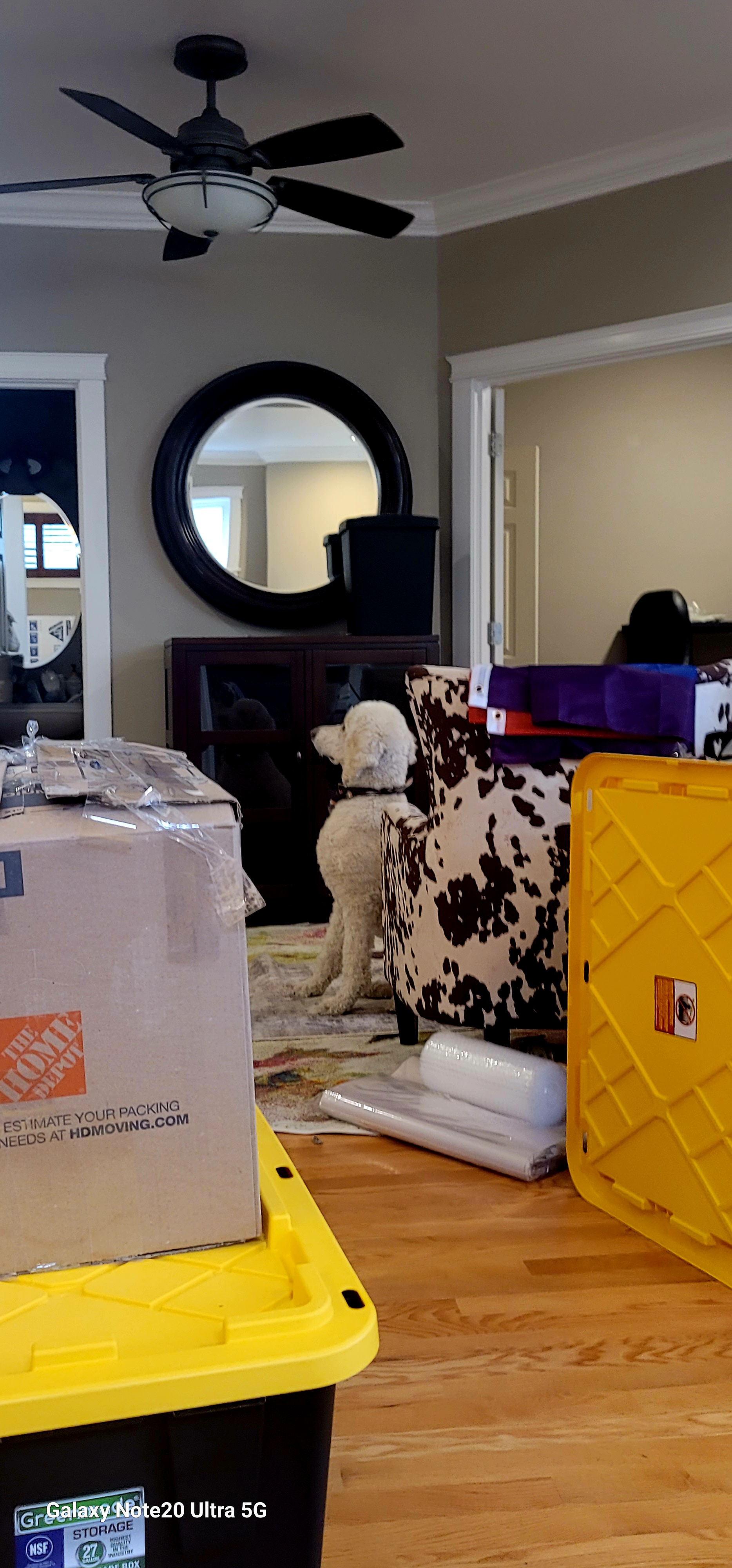
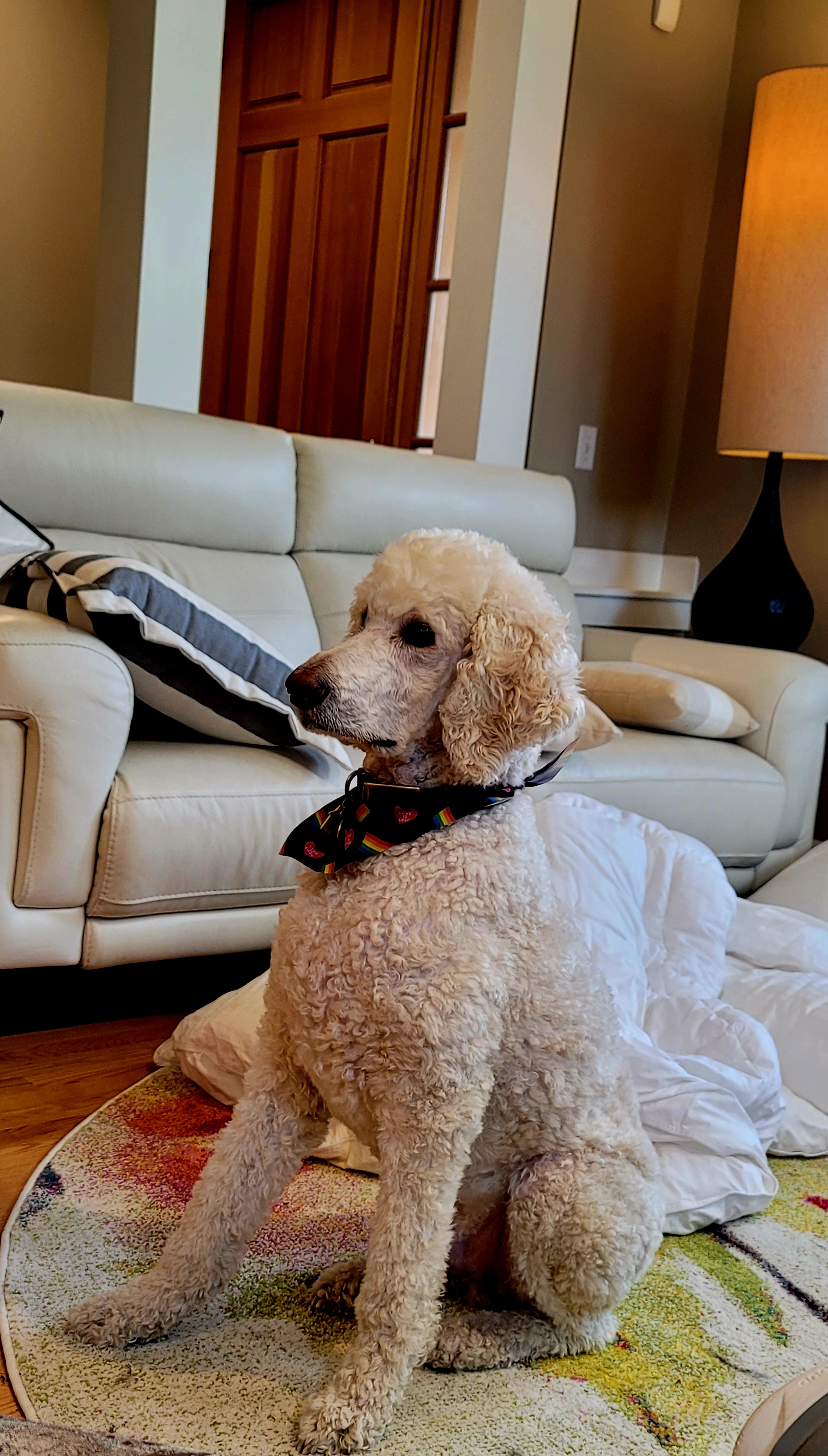
The people seated around us were very nice. We discussed where everyone lived, how long they had been in Las Vegas, swimming pools, neighborhoods, and, of course, our poodles. I can discuss the dogs. Beauregard and Oliver provide an impressive amount of conversational material.
But casual conversation is difficult for me. Give me a purpose, a project, or an agenda, and I can speak with almost anyone. Ask me to make small talk merely for the pleasure of making small talk, and I feel my internal candle beginning to burn down.
At first, the flame is bright. Then the wick gets shorter. Then the light begins to flicker.
Apparently, my social candle lasts approximately 4.3 minutes.
The bourbon may have extended its life slightly. It also loosened my vocabulary.
At some point, the conversation turned to dermatologists. I had recently endured a less-than-satisfying appointment and evidently felt rather passionate about the subject. A few words escaped that I do not normally use in polite company.
Rob leaned over and quietly suggested that I might want to stop dropping the F-bomb. I had not realized I was doing it.
Perhaps bourbon does not extend the social candle. Perhaps it simply sets fire to the tablecloth.
Two Ways to See a Room
Yet something else about that dinner stayed with me.
Twenty-four strangers had deliberately attended a social event. We were all seated at the same long table, but nobody stood up to introduce themselves. Nobody circulated. Nobody attempted to bring the table together.
We sat. We ate. We drank. We left.
How many of us were waiting for someone else to make the first move? Perhaps I was not the only socially awkward person at that table. Perhaps I was simply the one who went home thinking about it.
Rob can work a room. I remember it.
He moves easily from one conversation to another. I may speak with fewer people, but the next morning I can tell him what someone said, what they were wearing, where they came from, and the small detail that changed the conversation.
He opens the conversation. I remember the story.
That difference has made me wonder whether my difficulty with small talk will make it harder to build West Valley Pulse. How can I tell the stories of a community if I am not the person who naturally walks up to everyone in the room?
Then I realized that I do enjoy talking to people. I simply need a reason to begin.
Somewhere along the way, asking what someone does for a living apparently became impolite. We are told to ask what books they are reading instead. But what if they are not reading anything?
I want to know how someone built a career, why they chose it, what they learned, and how they arrived at this particular table in Las Vegas. I am not trying to determine their status. I am trying to discover their story.
Maybe the question does not have to be, “What do you do?” It could be:
“What keeps you busy these days?”
“What brought you to Las Vegas?”
“How did you get into that?”
“What is the most interesting part of your work?”
An honest question gives two socially awkward people somewhere to begin.
The Incomplete Story
I was reminded of that while collecting our auction pieces in North Summerlin. I encountered a gruff older man who initially ruffled my feathers. My first instinct was to keep my distance.
Then I noticed our similarities. We even drove the same car, although his was a different color.
Sometimes the person who unsettles us deserves a second look. What appears to be rudeness may be discomfort. What feels like rejection may simply be someone else struggling to begin.
Then again, the universe enjoys testing a new philosophy.
Four electrical contractors recently visited our house. Four collected service fees. Four left without producing an estimate.
Standing there in my flip-flops, I wondered what they saw when they looked at me. Did they assume I could not afford the project, or was I making assumptions about them?
That is the danger of observation. We are all watching one another, but none of us has the complete story.
At the end of it all, I am still processing this new landscape. I am learning to balance the noise of the Strip with the quieter rhythm of the desert.
I am also learning that social awkwardness may not be something that needs to be fixed.
Some people work the room. Others remember it.
Some people leave an evening energized. Others need Monday to recover from Sunday.
Some people can begin a conversation with anyone. Others need one honest question before they know where to start.
If you recognize yourself in any of this, you are not alone. Perhaps you are not antisocial. Perhaps you are simply taking in more of the room than anyone realizes.
We are all observing one another without knowing the complete story. Maybe what we need is a little less judgment, a little more curiosity, and enough patience to look twice.
Preferably before several bourbons on the strength of one scallop.
As for me, I am still finding my footing in the desert.
Did I mention I’m wearing flip-flops?